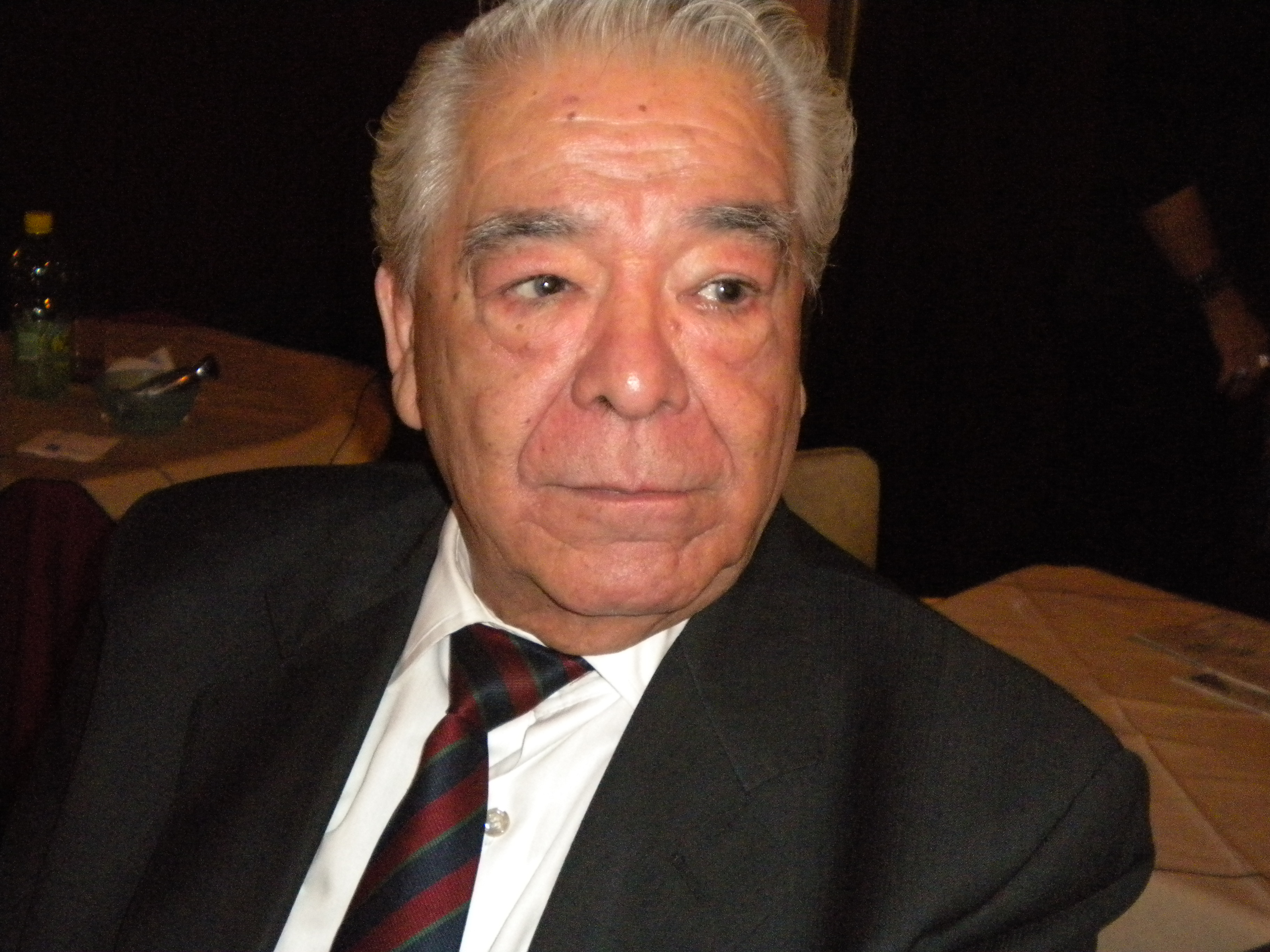
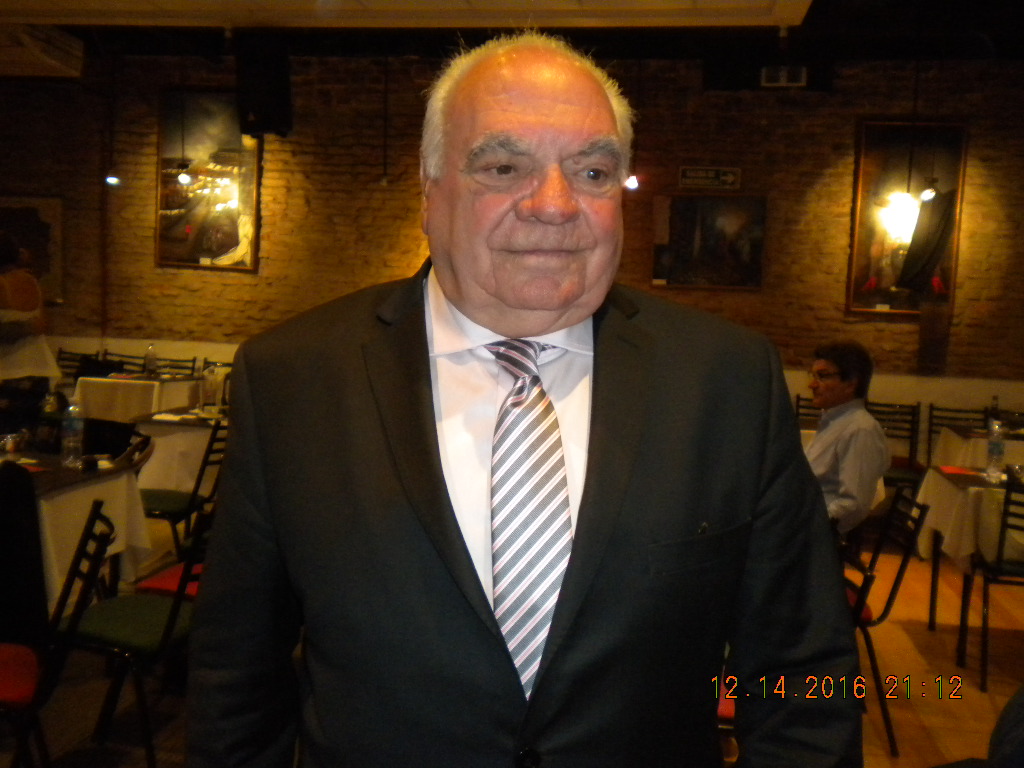
Mario Alan Candamil (May 13, 1929–)

May 13, 2008 by jantango
Born in Mexico, his family immigrated to Buenos Aires when he was three years old. I met Alito for the first time when I danced valses with him in Regin in November 1998. It was an “aha” moment for me.  I danced with a milonguero.
Alito organized dances over many decades in Palacio Rivadavia, Mariano Acosto, Club Almagro, Tourbillon, Club Savoy, Salon Agusteo, and Confiteria Piccadilly, among others. In September 2001, he and Miguel Angel Balbi were partners in a milonga known as “Buenos Aires Tango (Milonguero)” held in Mundo Latino on Esmeralda. They were forced to close it after only three months when the city was in turmoil with President de la Rua in office. Alito’s last milonga was in Plaza Bohemia in 2004. He set the admission at one peso, hoping to entice dancers to attend. Sadly, it never came to pass, and he lost money. One evening during his milonga, I was sitting with Alito. The deejay played a tanda of Alfredo De Angelis. Alito turned and said to me, “in my time, if they played De Angelis in a milonga, the disk jockey would have been taken to the street and shot. De Angelis was the music of the carousel, not the milonga.”
Last night Alito quietly celebrated his birthday at midnight in Club Gricel. We danced a tanda of Tanturi/Castillo—the only tanda he danced all night. Today, Alito and Osvaldo Centeno came to my apartment for lunch and conversation. Alito has a daughter (41) and a grandson (14) who live in Villa Urquiza. As Alito left my apartment a couple hours ago, he said he was going home to shower, change, and go to the milonga in Plaza Bohemia.  Alito is married to the milonga.


Dos flacos milongueros

May 8, 2008 by jantango

Rodolfo Cesar Indegno (May 8, 1931 –)


He is small and very thin, has never married and has no children to his knowledge, as he likes to joke. He has a reserved front row table in Lo de Celia where he dances regularly at least twice a week. He lives in the neighborhood of Chacarita. Two weeks ago, we danced a vals tanda before the floor was crowded. It was fabulous. All we could do was smile at one another.


Ernesto Hector Garcia (May 8, 1936 –)

He’s known as “El Flaco Dany” and could be called the Fred Astaire of Tango. He is slim and always smartly dressed in a double-breasted suit and tie. His specialty is milonga con traspie that he has taught in Italy and the United States. I saw him last Friday night at Salon Canning where he was singing more than dancing. I listened while he and Eduardo “El Nene” Masci sang the tangos they know and love so much. When the Miami festival organizer wrote me about inviting a milonguero, Dany was the one I arranged for her to hire. He went for three consecutive years to the Miami Beach festival to teach and perform. He lives in the family home in Villa Urquiza, not far from Club Sunderland, where he celebrates his birthday. Dany may be 72, but his dance partners are usually less than half his age.  (see photo in April 27 post)

Cafe de los Maestros

May 3, 2008 by jantango
Several years ago Gustavo Santaolalla decided to try to convince a group of tango musicians and singers to return to the recording studio and collaborate on a new project. He invited true maestros, all over 70 and as old as 90, to participate; three of them have died since the project began in 2003. First, there is a two-CD set of 27 tracks with background text on the musicians. It won the Latin Grammy for best tango album in 2006. The maestros were filmed during the recording sessions and participated in a concert at Teatro Colon in August 2006. The recording sessions and concert have been boiled down to a 93-minute documentary that was presented in February 2008, at the Berlin Film Festival. Finally, a book for Café de los Maestros will be published in English.

My friend Diana has a close association with two of the musicians of Café de los Maestros as the artistic director and executive producer of a compact disc by a tango singer. She invited me to join her at the Café de los Maestros reception on March 13, 2008, at the Academia Nacional del Tango where the maestros received certificates for their participation from Gustavo Santaolalla. Diana gave me the Café de los Maestros CD for my birthday a few weeks ago.

The studio where Café de los Maestros was recorded is located seven blocks from my apartment. Diana invited me to attend a recording session there today. As I walked the hallway, I discovered that this was the studio where every important Argentine recording artist has sung or played. Estudios ION is where Osvaldo Pugliese, Anibal Troilo, and Juan D’Arienzo recorded. The photos on the walls tell the story, as does the impressive list of artists who have recorded there since 1956. I entered the actual studio, where Café de los Maestros was recorded from November 2003 to September 2004, in order to film a recording session with Anibal Arias and Osvaldo Montes. I watched and listened in the control booth where Jorge Da Silva, the sound engineer for Café de los Maestros, was at the helm. It took three hours to record four tangos. I wouldn’t have missed a minute of it for the world.

Carlos Gavito — April 27, 1942-July 1, 2005

April 27, 2008 by jantango
I saw him for the first time on stage with Forever Tango at the Arie Crown Theater at McCormick Place in Chicago on April 25, 1996. That was ten years after Tango Argentino was presented at Arie Crown for one week. My two sisters saw Tango Argentino, but I didn’t. I was living in the suburbs without a car and couldn’t get to Arie Crown in 1986, so I made up for it by going to see Forever Tango five times during six months at the Royal George Theater on North Halsted Street.
During his time with the show in Chicago, Gavito was giving classes at Chicago Dance Studio. I had the pleasure of demonstrating with him during classes. He and the entire cast showed up one night at my milonga on October 12, 1996, at an Arlington Heights dance studio escorted by Bob Dronski and his wife Kathleen Kreher. Gavito encouraged Bob and Kathleen to open a space dedicated to tango in Chicago. There were few places to dance tango at the time. They were his proteges and put their hearts and souls (and lots of money) into the design of Tango…nada mas on Northwest Highway in Norwood Park. On May 3, 1997, they held their grand opening and, of course, their dear friend Gavito came all the way from Buenos Aires to be there.

The first “La Noche de Gavito y sus Amigos” was held at La Trastienda at Balcarce 460 in San Telmo on July 22, 2002. He invited six couples and two singers to perform in his show. Here is a photo from that night with Miguel Angel Balbi (”Pepino”), Ernesto Hector Garcia (”El Flaco Dany”), Carlos Enrique Gavito, and Ricardo Enrique Maceiras (”El Pibe Sarandi,” who was born one day after Gavito in the same hospital in Sarandi).


The tango embrace

April 25, 2008 by jantango

Osvaldo Centeno and Rosanna Remon

Osvaldo Centeno and Rosanna Remon

Years of ballroom dancing in Chicago never prepared me for what I was to experience during my first trip to Buenos Aires to dance tango in 1996. I received an embrace while dancing completely different from any I had before with any partner. Those nights of dancing with Argentine men in the milongas confirmed for me that tango is a feeling that is danced. Tango is an embrace.

I know many women who have found that special feeling in tango when dancing in the milongas with Argentine men. It’s a feeling of security and being protected while losing oneself in the music. We can forget all our troubles and be present in the moment. No other dance has the feeling of tango.

When I think of all the teachers who travel from Buenos Aires to teach in the United States and other countries, I am astonished that the importance of the embrace is rarely talked about in classes. It’s what dancers are missing until they arrive in Buenos Aires. The embrace is something teachers assume their students understand. It requires understanding the culture of tango from those who have lived tango for many years—the milongueros.

The embrace is mutual giving. He embraces me, and I embrace him. Our hearts beat together as we share three minutes of a story told in music. Our souls connect. Tango allows two to become one.


Milonga codes

April 23, 2008 by jantango
I think the codes of the Cosa Nostra and the codes of the milonga in Buenos Aires have things in common.

The Cosa Nostra (aka “mafia”) began during the middle of the 19th century, although confirmation of its existence in Italy wasn’t acknowledged until 1992. It is a brotherhood with rituals, rules of behavior, and a code of honor–don’t talk, listen, and observe. The codes are unwritten and passed on by word of mouth by its members. They are codes for life. The mafia exists in only two countries in the world–Sicily and the USA since many Italians immigrated to New York before World War I.

From 1870-1914 (when tango’s predecessor the milonga was being created by musicians), there was a large migration of Italians to Buenos Aires. Many of the poets and composers of tango were of Italian descent—Miguel Calo, Carlos Di Sarli, Homero Manzi, Enrique Discepelo, Julio DeCaro, etc. The codes of the milonga pattern those of the mafia in many ways—behavior, silence, respect and nothing being written. With so many Italians living in Buenos Aires at the turn of the century, it’s no surprise that the codes of the milongas were established and passed on the same way as the mafia tradition has functioned for generations.

Buenos Aires and tango are so closely linked by history and culture, that if you separate them, you end up with something else. Milongas in the USA hardly resemble those of BuenosAires. Milongas were called that because of the presence of milongueros. Americans hold tango parties for socializing, not milongas. In BuenosAires, one’s personal life is left at the door. Tango is more than a dance for the milongueros–it is their life, what they have lived.


Lo de Celia Tango Club

April 21, 2008 by jantango

The space was formerly known as Re-Fa-Si (which was named after the tango by Enrique Delfino). In fact, Marina Palmer mentions dancing at Re-Fa-Si in her book, “Kiss & Tango,” on page 111. I danced at Re-Fa-Si for the last time in January 2000, just before it closed due to the death of the owner.

Celia Blanco took over the space and spent months renovating it for her grand opening on July 14, 2000. I lived three blocks away on Virrey Cevallos and Carlos Calvo at the time, so I went to dance as many as four nights a week. At first, Celia’s was open only on the weekend, but eventually there were milongas on other nights.

I consider Lo de Celia my second home, and I know others who feel the same way. The staff sets this milonga apart from all others. Claudio is the security guard at the street door. Mario collects the entradas. Olga, his wife, manages the coat checkroom. Dario greets everyone and controls where everyone sits. Johnny and Rosario are the friendly waiters. Daniel Borelli is the best deejay of all the milongas in Buenos Aires. Silvia is the friendly attendant in the ladies’ room who takes care of everything. Celia is always there to make certain that everything runs smoothly.

I have a reserved table on Wednesdays in a corner next to the bar. It’s convenient to check with Daniel for the name of an orchestra, etc. Here’s the view from my table. The two men seated in front of the bar are Roberto Angel Pujol (left) and Orlando (right, who died two years ago). Lo de Celia (corner of Humberto Primo and Entre Rios) is the place I enjoy dancing more than any milonga in Buenos Aires. And the best thing is it’s only nine blocks from my apartment.


Three milongueros

April 18, 2008 by jantango

“Lolo” Garaban – April 19, 1932—June 2, 2003

I had the pleasure of dancing with Lolo whose favorite orchestra was Francisco Canaro. This milonguero never married but was “engaged” in December 2001, when he and Aura exchanged rings at a private party in her house with all his milonguero friends. They were the couple everyone watched when they danced milonga con traspie. Here is a photo of them dancing salsa in Club Gricel (July 2001).


Nestor Ray (Salvador Pedro Raiano) April 19, 1945—May 22, 2003

He was born in Villa Ballester, province of Buenos Aires. His tango school was the milonga and the street. Nestor was a jockey. He accompanied Robert Duvall around the United States when he was filming movies. I met Nestor for the first time at a swing dance convention in Atlanta in May 1996, where he and Duvall danced a tango. I danced with Nestor in San Francisco and Buenos Aires. He traveled to teach tango in Europe and the USA during the last 12 years of his life with his partner Patricia.


Clodomiro “Tito” Ortega (April 19, 1935–)

I don’t know much about Tito other than his dancing. I haven’t seen him in the milongas for a long time. I remember dancing with him in El Arranque, the day I snapped this photo of him–June 26, 2003.

Milonga codes

April 17, 2008 by jantango

I had my first introduction to the milongas on my first visit to Buenos Aires in March 1996. I began watching and learning how things were done differently in Regin, Almagro,  Gricel and other milongas. When I think back to my first nights of dancing in those clubs, I had so much to learn about the codes and customs. Fortunately, I’ve had help along the way from the milongueros.

Women hear music, and they want to dance. We’ll dance with any man who asks us that is, until we figure out he doesn’t know how to dance. Patience is a difficult lesson for us to learn when it comes to dancing in the milongas of Buenos Aires, but it certainly worthwhile. I would rather sit and listen to the music than dance with a man who doesn’t dance well. A tanda is only ten minutes, but it will seem like an eternity in the arms of a man who pushes you around or who can’t connect to the music.

A milonguero will not invite a woman to dance until he has seen her dance. I’ve learned to do the same before accepting an invitation. I went to Gricel last Friday night and saw a man whom I had never seen before in the milongas. I thought he danced fairly well. Later, I was dancing with a milonguero and saw the other man watching me. When he invited me for a tanda, I was reasonably sure I wouldn’t regret it. We checked out each other’s dancing before we danced together. I accepted a second tanda with him. He told me that he waited to see how I danced before he invited me. That confirms he is someone who wants to dance well or not at all.

A few hours ago in Lo de Celia, the woman with whom I shared a table decided to accept the invitation of a man for the Osvaldo Pugliese tanda. He was seated close to our table and had recently arrived. She wanted to dance, so she took her chances. I warned her and predicted disaster, which she confirmed at the end of the tanda. We both agreed that we would rather sit and enjoy the music than dance with a man who doesn’t dance well. I danced only four tandas in three hours, but they were with Antonio, Rodolfo, and Anibal, all excellent dancers.   Patience is a code of the milongueros worth learning.

Hernando’s Hideaway

April 15, 2008 by jantango
On Sunday I went to my favorite milonga in Buenos Aires—Lo de Celia, at the corner of Humberto Primo and Entre Rios. I usually go Wednesday evenings, but decided I needed to dance on Sunday. Twenty-something-year-old Viviana is deejay, and she has a more eclectic choice of recordings than the regular deejay Daniel Borelli, 38, who keeps everyone happy with the best.

I go to the milongas to dance, to listen to the music, and watch the dancers. I wasn’t dancing at 9:15 when I heard a very familiar tune. I couldn’t believe what I was hearing, so I walked over to the bar to talk with Vivi. It sounded like a tango from the USA entitled, “Hernando’s Hideaway.” De Angelis recorded it. The title in Spanish is, “Escondite de Hernando.”

After arriving home, I browsed the internet in search of the origins of this tango. I wanted to know if “Hernando’s Hideaway” was from Buenos Aires or the USA. My search revealed that the music and lyrics were written by Richard Adler and Jerry Ross for their Broadway musical, “The Pajama Game,” that won a Tony award in 1954. Archie Bleyer, arranger and band leader, made the most popular recording. Everyone from Doris Day and Ella Fitzgerald to Guy Lombardo and Harry Connick, Jr. made recordings of it. Hernando’s Hideaway was used in the movie, “Some Like It Hot,” with Jack Lemmon, who dressed as a woman, dances tango with Joe E. Brown.

This is the first time I’ve heard an American tango recorded by an Argentine orchestra played in a Buenos Aires milonga. Vivi informs me that “Escondite de Hernando” is being played in the milongas. You won’t hear it with lyrics, but you may recognize the tune.  Just to refresh your memory . . .

I know a dark secluded place,
A place where no one knows your face,
A glass of wine, a fast embrace
It’s called Hernando’s Hideaway
Ole!